

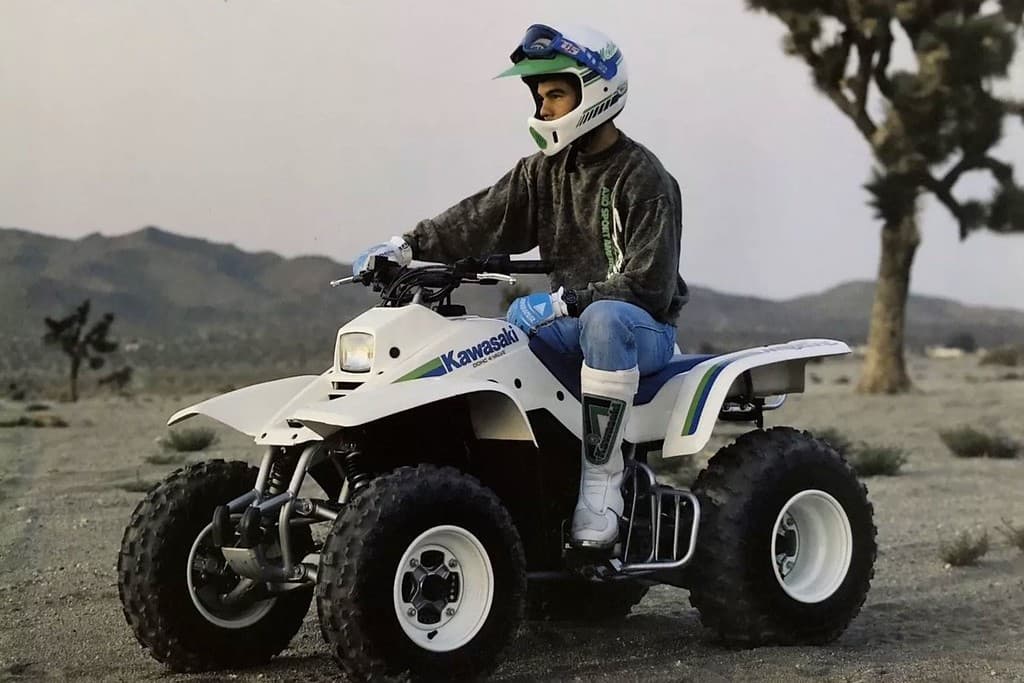

Long before today’s Kawasaki KFX models, a small sport ATV held a special place in the Japanese manufacturer’s lineup for nearly two decades: the Kawasaki Mojave 250.
Introduced for the 1987 model year, the Mojave didn’t have the massive displacement or horsepower figures of the larger sport ATVs that would eventually dominate the market. Yet thanks to its four-stroke engine, manual transmission, relatively compact dimensions, and a design that remained remarkably consistent over the years, the Mojave accomplished something rather unusual in the powersports industry: it remained in Kawasaki’s lineup through 2004.
Let’s look back at the history of the Kawasaki KSF250 Mojave, an ATV that left its mark on an entire generation of sport riding enthusiasts.
1987: The Kawasaki Mojave 250 Is Born
The Mojave 250 made its debut for the 1987 model year under the designation KSF250-A1.
At the time, the all-terrain vehicle industry was undergoing a major transformation. Manufacturers were developing a new generation of four-wheel ATVs, and Kawasaki already had considerable experience in the off-road vehicle market.
The Mojave followed a different philosophy than a pure competition machine. Kawasaki instead offered an accessible and versatile sport ATV capable of delivering plenty of fun on the trails while still providing respectable performance.
That formula would allow the Mojave to survive for years without undergoing major fundamental changes.
A 249cc Four-Stroke Single-Cylinder Engine
At the heart of the Mojave was one of the features that helped define its personality: its engine.
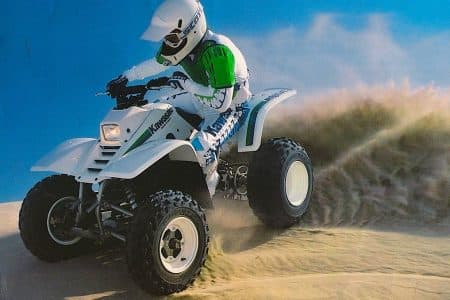
The KSF250 used a 249cc liquid-cooled, four-stroke, DOHC single-cylinder engine.
Bore and stroke measured 74 x 58 mm, while the compression ratio was 11:1.
Fuel was delivered through a Keihin carburetor.
At a time when two-stroke engines still played a major role in the sport ATV world, the Mojave’s four-stroke configuration gave it a different personality. Its power delivery was more progressive, making it particularly well suited to recreational sport riding and to riders learning how to operate a manual ATV.
A True Manual Transmission
The Mojave wasn’t an automatic ATV.
It featured a five-speed manual transmission with reverse, combined with a wet multi-disc clutch.
Power was transferred to the rear wheels through a chain final drive.
This configuration contributed greatly to the Mojave’s sporty character. Riders had to manage the clutch and gears just as they would on many other sport machines of the era.
The addition of reverse, however, was a welcome advantage for an ATV also intended for recreational trail riding.
A Machine That Changed Very Little
One of the most interesting aspects of the Mojave’s history is precisely how little its fundamental mechanical design changed.
Unlike many vehicles that undergo a complete redesign after only a few years, Kawasaki retained the basic KSF250 formula for virtually its entire production run.
From 1987 through 2004, the Mojave remained based on the same general architecture.
Kawasaki naturally introduced different colors, graphics, styling updates and various adjustments throughout the years, but the fundamental philosophy of the machine remained largely unchanged.
That consistency would eventually offer another benefit: even today, the Mojave enjoys a relatively strong aftermarket, with replacement components compatible with numerous model years.
A Recreational Sport ATV Rather Than a Pure Race Machine
It’s important to understand the Mojave in the context of its time.
It wasn’t necessarily designed for riders looking for the most radical performance ATV available.
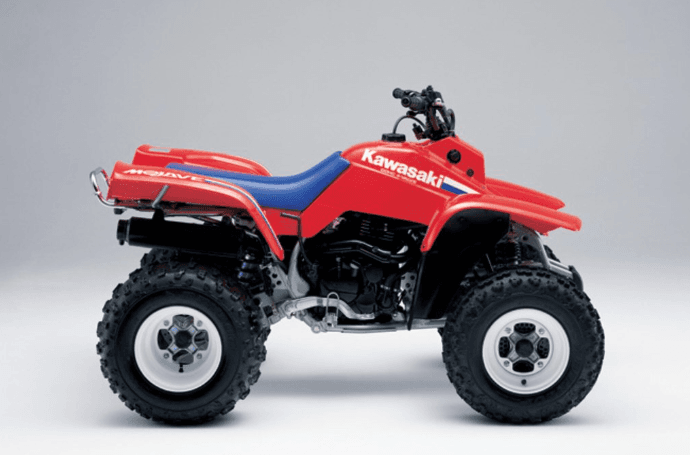
Its mission was closer to that of a recreational sport ATV.
The 249cc engine provided enough character to make the machine entertaining, while its dimensions and performance remained more approachable than some of the high-performance machines of the era.
That combination made the Mojave particularly appealing to riders looking to move into a true manual sport ATV without immediately stepping up to a larger-displacement machine.
The 1990s: The Mojave Keeps Going
The ATV market changed dramatically throughout the 1990s.
Utility machines became increasingly important, while sport ATVs continued to attract a passionate following.
Yet the Mojave made its way through the decade without losing its identity.
The model years kept coming:
1987, 1988, 1989, 1990, 1991, 1992, 1993, 1994, 1995, 1996, 1997, 1998, 1999…
And then the Mojave entered the new millennium.
Few sport ATVs can claim such a long production run while retaining such a consistent platform.
The Transition to the KFX Name
In the early 2000s, Kawasaki began modernizing the identity of its sport ATV lineup around the KFX name.
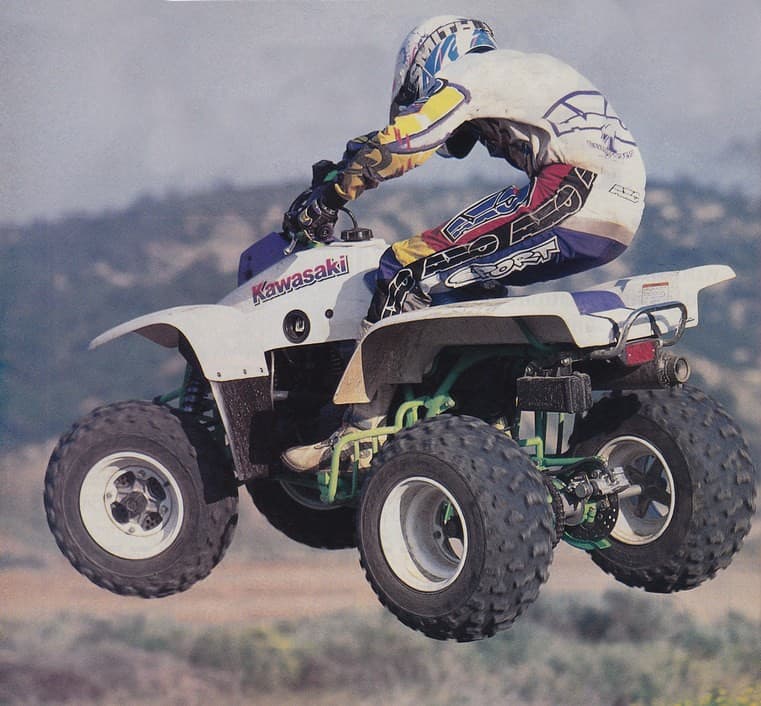
The Mojave eventually reached its final model year in 2004, when Kawasaki listed it as the KFX250 Mojave.
Underneath, it remained the KSF250 platform, identified as the KSF250-A18.
The change in name illustrates the transition taking place within Kawasaki’s sport ATV lineup.
The Mojave belonged to an earlier generation of machines, while the KFX family increasingly represented Kawasaki’s future in the sport ATV segment.
A New Generation of Kawasaki Sport ATVs Arrives
By the time the Mojave was nearing the end of its career, the sport ATV market had changed dramatically.
Riders increasingly wanted more horsepower, greater suspension travel and improved overall performance.
Kawasaki offered the KFX400 in the early 2000s, powered by a 398cc four-stroke engine and featuring a much more modern chassis and suspension package.
The company also offered the spectacular KFX700 V-Force, powered by a 697cc V-twin engine.
Compared with this new generation of machines, the small Mojave’s design, which dated back to 1987, was inevitably beginning to show its age.
2004: The End of the Kawasaki Mojave
The 2004 model year marked the end of the KFX250 Mojave.
After approximately 18 model years, Kawasaki discontinued one of the longest-running models in its sport ATV lineup.
Why?
Kawasaki does not appear to have published a detailed official explanation attributing the Mojave’s discontinuation to one specific reason.
However, the market conditions of the time provide some important context.
The sport ATV market was rapidly moving toward larger-displacement and more technologically advanced machines. The KFX400 now occupied a much more contemporary position in Kawasaki’s sport lineup, while the KFX700 targeted riders looking for substantially more power.
Against that backdrop, continuing to offer a 250cc platform whose fundamental design dated back to the late 1980s was becoming increasingly difficult to justify.
It is therefore more accurate to view the Mojave’s disappearance as part of the evolution of Kawasaki’s lineup and the sport ATV market rather than attribute it to a specific cause that Kawasaki itself never officially confirmed.
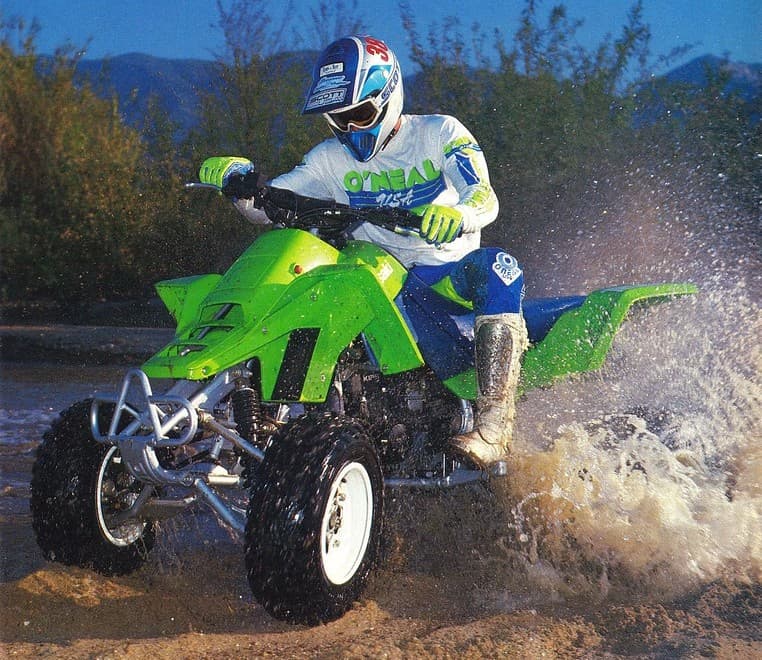
Kawasaki Mojave 250 Specifications
Engine: Four-stroke single-cylinder
Displacement: 249cc
Valve train: DOHC
Cooling: Liquid
Bore x stroke: 74 x 58 mm
Compression ratio: 11:1
Fuel system: Keihin carburetor
Transmission: Five-speed manual with reverse
Clutch: Wet multi-disc
Final drive: Chain
Fuel capacity: Approximately 8.3 liters
Dry weight: Approximately 165 kg (364 lb)
Some specifications and equipment may vary depending on model year and market.
Why Is the Mojave Still Interesting Today?
More than 20 years after production ended, the Kawasaki Mojave continues to generate interest among vintage ATV enthusiasts.
Its long production run is already a significant part of its appeal.
But its relatively simple mechanical design, four-stroke engine, manual transmission and sporty character also make it an interesting restoration project.
The continued availability of various maintenance and replacement parts also helps keep surviving Mojaves on the trails.
And then there’s nostalgia.
For many ATV enthusiasts who discovered the sport during the 1980s, 1990s or early 2000s, the Mojave represents an era when a 250cc sport ATV could provide an enormous amount of fun without needing huge horsepower numbers.
A Remarkable Career for the Kawasaki Mojave
From 1987 through 2004, the Kawasaki Mojave managed to survive for nearly two decades in an industry known for rapid change.
Its formula was relatively straightforward: a 249cc four-stroke single-cylinder engine, a true manual transmission, a sporty chassis and enough versatility to spend countless hours exploring the trails.
The Mojave may never have been the most powerful sport ATV of its generation.
But that wasn’t necessarily its purpose.
Instead, it offered an accessible entry point into manual sport ATV riding, backed by a proven mechanical package that Kawasaki kept in its lineup for 18 model years.
Today, as modern sport ATVs have reached levels of power and sophistication that would have seemed unimaginable in 1987, the Kawasaki Mojave 250 remains a fascinating reminder of a very different era in ATV history.
And that is precisely what has helped turn this modest 250 into a small classic among ATV enthusiasts.